1Two Words
A nation state is built from two words, and the second is the newer, stranger half. The state is easy: the supreme executive authority, sovereign over a territory. A crown, a capital, an army that answers to it. The nation is the complication: the idea of a people bound by a shared identity, whether that identity is built from language, culture, history, or blood.
For most of history the two words did not travel together. The Jews were, for the longest time, a nation without a state: a people with a shared language, culture, and history rooted in the Bible, and no sovereign territory of their own, until the founding of Israel finally welded the two halves together. The Kurds today, scattered across four countries in the Middle East, sit in that same unresolved position now: a people, but not a state.
Fuse the two words, nation plus state, and you get probably the single most powerful ideology in human history. It has built astonishing things. It has also produced two of the deadliest wars ever fought. This is a map of how that fusion happened, and of where it is taking us now.
2The Fourth Solution
Three separate historical pressures converged to produce the nation state: a religious crisis, an economic transformation, and a social and cultural upheaval. Start with the religious one, because it runs the deepest.
The starting point is the Protestant Reformation. Reformation theology put the individual in direct, unmediated contact with God and removed the Catholic Church as the go-between. Before the Reformation, a believer simply obeyed the Church, and obedience guaranteed heaven. After it, the individual had to demonstrate constant, absolute faith directly to God, with no institution standing between them and salvation.
That created a psychological problem. How can anyone be certain they believe, every single day, without wavering? You love your mother, but do you love her with equal intensity every day, all the time? Probably not, and that kind of inconsistency is tolerable in a human relationship. Doubt toward God is not. It risks damnation. This was a genuine crisis of faith, and it produced four competing solutions, each of which grew into a major modern ideology.
The first was to replace God with money. The Calvinists held that if a person is called to accumulate wealth, and does, the accumulation itself is evidence of God's favor. This was the theological seed of capitalism. The second was to replace God with reason: pursue reason, demonstrate enlightenment, and that becomes your proof of faith. This produced the Enlightenment and liberalism. The third was to replace God with the self: self-discovery and personal growth as the path to salvation, an idea that runs from Freud and Jung down to the wellness culture of the present day.
The fourth solution was to place God inside the nation, and of the four, it proved the most powerful, resilient, and enduring. The first three all leave the individual isolated from other people; they solve the crisis of faith but create a second problem, alienation. The nation, a community of individuals sharing an identity by definition, solves both at once. It is a conflation of religion and politics in a single package, and that conflation is exactly what gives it such enormous emotional power. Purely as a religious matter, the nation state answers the problem of faith and the problem of alienation with the same gesture.
3The Bourgeois Bargain
The second root is economic, and it runs through the Industrial Revolution. Two problems stand out.
First, industrial economies need constant expansion (new markets, new raw materials), which builds imperialism into the system from the start. Second, the Industrial Revolution produced an entirely new elite, the bourgeoisie, the industrialists and capitalists, displacing the priests and warriors who had held that position for centuries. This new elite wanted political power, yes, but more specifically it wanted secure property rights: an assurance that wealth, once made, could be protected and passed down: to children, to grandchildren, to great-grandchildren.
Monarchy could not guarantee that. A king can be overthrown, and repeatedly was, across European history. A nation state cannot be overthrown the same way. The nation state was the bourgeoisie's answer to its own need for durable property rights, and it came with something extra: the resources and the appetite for imperial expansion that monarchies, being conservative institutions more interested in preserving the existing order through shifting alliances than in aggressive conquest, mostly lacked. The nation state, in short, is built to be aggressive, expansionist, and imperial.
4Anomie, Alienation, Disenchantment
The third root is social and cultural. The Industrial Revolution drove mass urbanization, villagers into cities, alongside a market that now circulated goods across an entire country, forcing systemization and standardization, and speeding up the movement of people, goods, and ideas. Print technology accelerated literacy and the flow of information. This period was an early form of globalization, not unlike the way the internet today floods people with new ideas faster than they can absorb them.
For most people at the time, that speed was disorienting rather than liberating, and it produced three distinct psychological effects. Anomie: the loss of cultural rootedness, as inherited values fail to keep pace with a changing world. Alienation: a sense of powerlessness, no agency in the face of change moving too fast to control. Disenchantment: the sense that all of it is dehumanizing, reducing people to something mechanical, not so different from the present-day anxiety about AI replacing human roles.
Three competing solutions to that disorientation emerged: communism, liberalism, and nationalism. Communism preached international solidarity, which was, if anything, even more confusing for ordinary people to hold onto. Liberalism preached individual rights, but rights to free speech and organization meant little in practice to someone who was poor, and most people at the time were poor. Nationalism offered something intuitively powerful instead: the idea that we are one people, locked in struggle against other peoples.
Nationalism had one more advantage over its two rivals: flexibility. Unlike communism or liberalism, it can absorb other ideologies instead of competing with them. A person could be, and many were, both a nationalist and a liberal, or, as with a figure like Stalin, both a nationalist and a communist. That capacity to absorb and subordinate rival ideologies is the reason nationalism, of the three, ended up on top.
5The Game Everyone Was Forced to Join
The nation state's spread across the globe can be explained with a simple game-theory thought experiment. Imagine millions of people playing some game independently: checkers, chess, tag, it doesn't matter which. Now imagine a small subset of them, three, four, five people, deciding to coordinate and play as a team, for whatever reason: family ties, friendship. That single decision forces everyone else to band together into groups too, or risk losing.
That dynamic is the essence of the nation state's spread. Once France declared itself a nation state, Germany, Russia, and Italy were effectively forced to follow suit or fall behind in the larger international game.
A second consequence follows from the same framework. Once every player has grouped into a nation state, victory in the larger game depends not on a state's size, wealth, or territory, but on its cohesion: its unity of will. Picture a bar fight between four brothers and ten strangers. The four brothers win more often than the numbers suggest, because loyalty makes them fight harder for one another, while the ten strangers, with no real stake in each other's survival, are far more likely to scatter under pressure.
That explains how the shell spread across the globe. It doesn't yet explain what filled it: the intellectual content each new nation state actually poured into the shape it had been forced to adopt. Two traditions supplied that content: the Enlightenment and Romanticism.
The Enlightenment is the seventeenth-through-nineteenth-century European current that elevated reason, science, literacy, and open debate. Romanticism arose as a direct reaction against the anxieties the Enlightenment itself produced, in particular the idea of deism, in which God sets the rules of the universe and then withdraws, leaving people to fend for themselves, an idea that generated real existential unease. The Romantics answered with nature instead of science, a divinity accessible through nature rather than through argument, individual will as a force capable of shaping history, and a rejection of materialism in favor of something more spiritual.
6The General Will
On the Enlightenment side, the central figure is Jean-Jacques Rousseau, whose book The Social Contract argues that individuals are born free, with inalienable rights (life and liberty among them), and voluntarily surrender some of those rights in exchange for security and collective prosperity. Out of that exchange emerges what Rousseau calls the general will: the collective mind of the people, the thing from which government derives its purpose, which is to serve and protect that will and, by extension, the rights of the people who hold it. Lincoln's "of the people, by the people, for the people" is essentially a restatement of Rousseau, a century later and an ocean away.
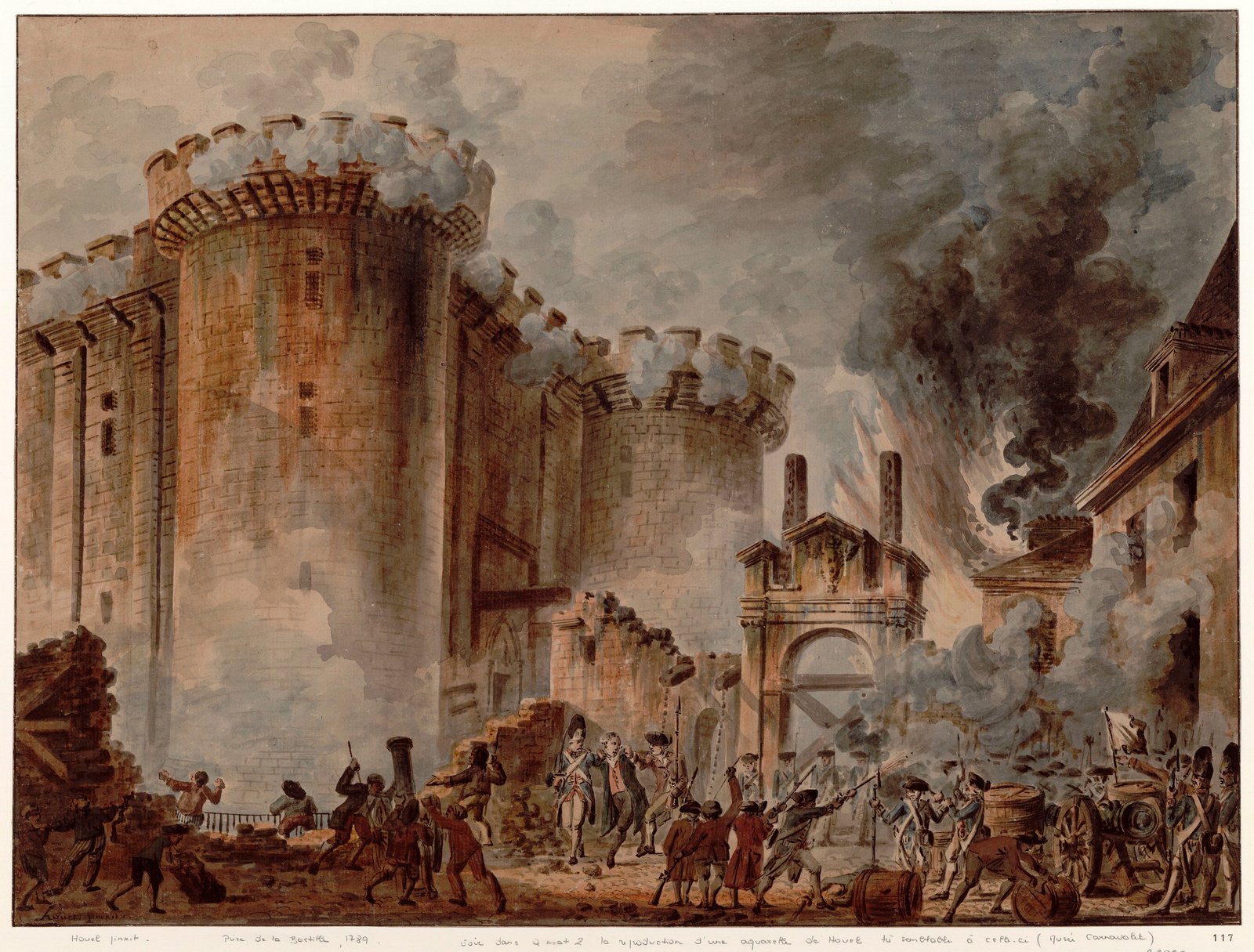
The French Revolution and Napoleon put the idea into practice, giving the world its first working iteration of the nation state. Its real significance was conceiving of the country as a single unified body, a sharp break from monarchy, where the monarch, the people, and the military were treated as separate spheres, and where kings routinely hired foreign mercenaries to fight their wars. Once the nation was conceived as one unified whole, ordinary citizens could be mobilized as soldiers at a scale nobody had imagined before, and because they believed they were fighting for themselves rather than for pay, they fought with a motivation no mercenary force could match. That mass mobilization is the mechanism that let revolutionary France sweep across Europe, conquering Spain, Italy, and parts of Germany.
7Scattered Bones
French conquest bred resentment among the peoples it now ruled: people who had run their own local affairs and now found a foreign political, economic, and social order imposed on them by occupying troops. Germany's case has a specific trigger. In 1805, Napoleon crushed the Russians and Austrians at Austerlitz. By tradition, that should have made him Holy Roman Emperor. Instead, the reigning emperor dissolved the empire outright rather than hand its throne to Napoleon, a devastating blow to German intellectuals, for whom the Holy Roman Empire had stood for a thousand years, its lineage running back through Charlemagne to Rome itself. Napoleon then created the Confederation of the Rhine to replace it, in effect a vassal state of France, which only deepened the German sense that their culture and history were being erased. And Germans, crucially, still had no strong pre-existing sense of Germanness to fall back on. It was that vacuum, combined with resentment at French domination, that German intellectuals set out to fill by constructing a new German national identity from scratch.
The response, shaped by Romanticism rather than Enlightenment rationalism, took a different shape from the French model. Instead of starting from the individual, this new nationalism started from a pre-existing culture, which creates a people, who in turn owe that culture a duty: to protect it, enhance it, spread it, with the nation state as the vehicle for doing so.
Two figures founded this current. Ernst Moritz Arndt, a poet remembered as the father of German nationalism, urged that the animosity of one's heart be one's church, that the nation be one's religion, that hatred of the French be one's religion, and that freedom and fatherland be the saints one prays to. Johann Fichte, a student of Kant and a founder of German idealism, argued that what unites a people cannot be a shared history, since Germans had different regional histories, but must instead be a shared language, German, through which cultural identity and character, gist, find expression. Fichte pictured national unity as scattered bones, reanimated and joined into a single new living body.
Put the contrast in one line: Enlightenment versus Romanticism maps onto science versus nature, reason versus emotion, liberty versus will and struggle; and, respectively, onto French nationalism, built on the general will, what serves everyone's interest, and German nationalism, built on gist, the spirit of the people, with the nation itself functioning as a kind of church.
8Measuring the Republic
Two scholars supply the evidence for how deep this went. James Scott's Seeing Like a State documents the standardization of measurement in France, the adoption of the metric system, as a case study in the larger project of systemization the nation state required. Three forces converged to drive the metrical revolution: market exchange favoring uniform measures, Enlightenment philosophy and popular sentiment favoring a single national standard, and Napoleonic state-building enforcing the metric system across France and its empire. The equalization of measurement was part of a larger simplification, in which French people stopped being mere subjects of local lords and became instead bearers of equal legal rights as citizens, reinforcing the nation state's self-image as guarantor of individual rights.
Benedict Anderson's Imagined Communities traces the role of print and language in making national identity conceivable at all. Pre-national Europe had no real concept of a standardized national language, people simply spoke whatever was local, and no developed concept of race either. Print technology changed that by spreading a standardized language, which let people imagine themselves sharing a common history and identity, even though that shared culture and history are ultimately constructed rather than intrinsic. Before the nation state, Europe's elites communicated across borders largely through intermarriage, with little sense of national identity. The rise of print and a standardized national language then built linguistic and cultural walls that made it harder for the mobile bourgeoisie to move capital freely across a multilingual Europe.
Rousseau's Social Contract states directly that Christianity preaches only servitude and dependence and is favorable to tyranny, an early articulation of the separation of church and state. That same church-state divide still plays out in France today through laïcité, the strict rule that public institutions stay neutral toward religion, which is why French public schools can legally ban visible religious symbols, hijabs included, a ban that remains a live source of tension with the country's religious minorities.
Underneath all of this sat three deeper structural breaks with the monarchy the nation state was replacing. First, the source of authority: in a monarchy, the bureaucracy holds ultimate authority as the monarch's representative; in a nation state, authority rests with the people, or with the culture, instead. Second, the elite: in a monarchy, the aristocracy is the elite class, rewarded by royal favor; in a nation state, the bourgeoisie, industrialists and capitalists, occupies that seat instead. Third, orientation toward change: monarchies keep the peace through shifting alliances among conservative monarchs bent on preserving the existing order, as at the Congress of Vienna in 1815, where Europe's monarchs agreed to stop fighting one another, a settlement that held until the revolutions of 1848. The nation state, by contrast, behaves almost like a new religion, demanding standardization and universal buy-in from its citizens, which makes it either costly abroad, through war and expansion, or costly at home, through the machinery of cultural conformity.
9J'Accuse
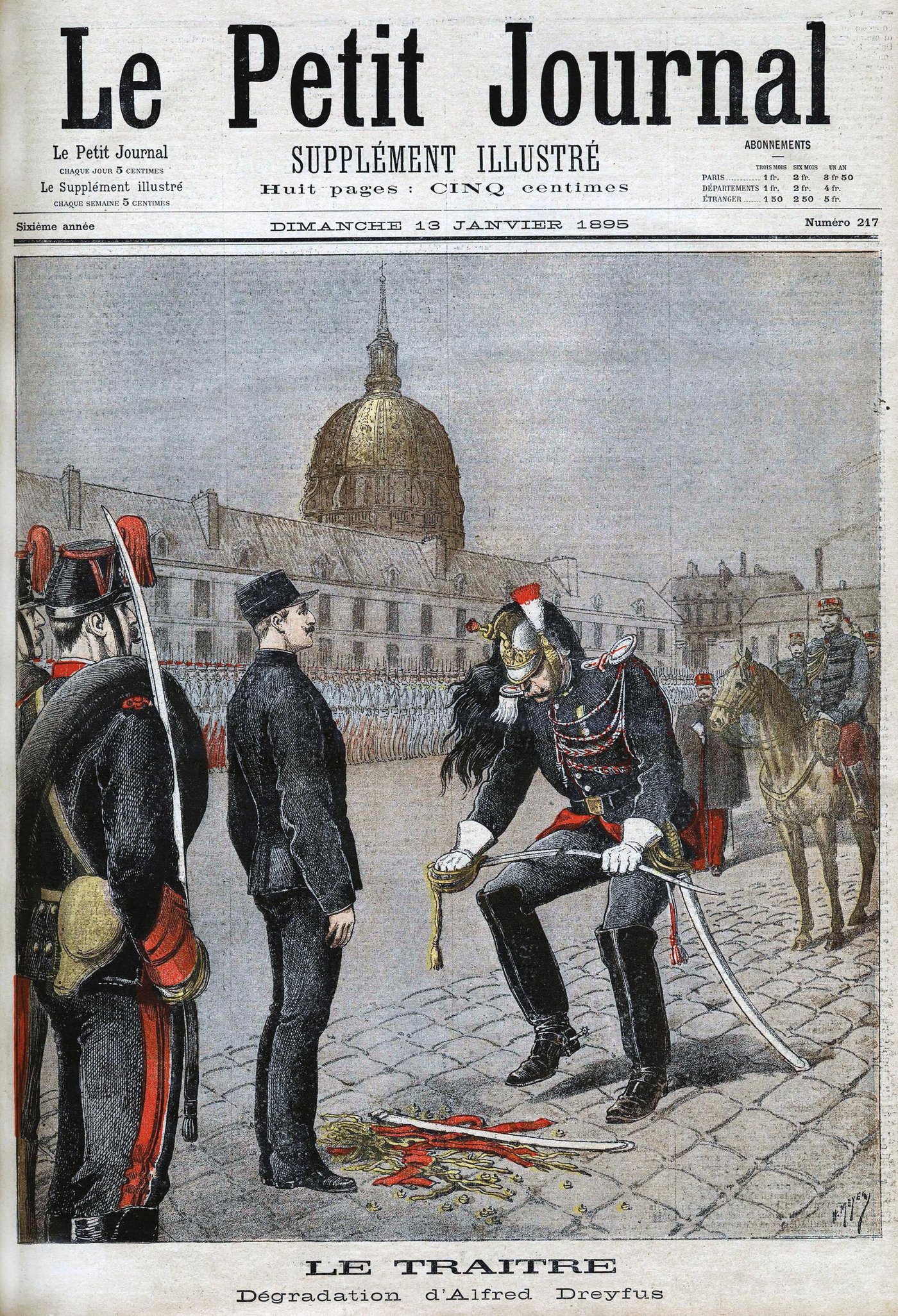
To see the difference between French civic nationalism and German cultural nationalism up close, look at how each country treated its Jewish population: the so-called Jewish question. Jews were, by the earlier definition, a nation: a people with a shared language, culture, and history rooted in the Bible, but no state of their own, which made them an awkward case for nation states built around a single people.
The Dreyfus Affair of 1894 is the French test case. Alfred Dreyfus, a French military officer of Jewish descent, was accused of spying for Germany. French counterintelligence quickly worked out that he wasn't the spy. But rather than admit the error, and pushed by antisemitic elements inside the military, the establishment convicted him anyway and shipped him to a penal colony. When the affair went public, the novelist Émile Zola published his open letter, J'Accuse, charging the French military and state with corruption, incompetence, and negligence.
The decade-long controversy that followed was never really about Dreyfus. It was about French identity. French liberals, seeing themselves as heirs to the Revolution, argued that if the rights of any one citizen could be violated, the rights of all citizens were at risk: that Dreyfus, whatever his ethnicity, was first and foremost a French citizen entitled to the state's protection. That is French civic nationalism working exactly as designed: a nation that exists to protect the rights of its citizens regardless of background.
Germany's answer to the same underlying tension was, by brutal contrast, simply the Holocaust: the endpoint of a nationalism built around ethnic and cultural belonging rather than shared citizenship.
10The Gene Pool
Before 1848, Europe's monarchs saw nationalism chiefly as a threat, since it implied handing authority away from the crown. The revolutions and rebellions that swept the continent that year convinced monarchs in states like Germany that the tide of social change could not be held back, and that nationalism could instead be co-opted, turned into a tool for managing and containing that same change.
Then Darwin gave the co-optation a new vocabulary. On the Origin of Species undermined the idea of a divinely designed human order, replacing it with random chance and natural selection, an opening quickly exploited to argue that if human traits arise through blind evolutionary processes, some peoples might simply have evolved to be superior to others. That claim was used at the time to assert European superiority over Africans and Asians, reinforced by pseudo-scientific practices like skull measurement meant to prove differences in intelligence between populations.
That fed straight into the eugenics movement, associated with Francis Galton, Darwin's cousin, who worried that modern sanitation and medicine were letting people who would once have died survive and reproduce, diluting the gene pool. Three eugenic remedies were historically proposed, and in some places carried out: forced sterilization of the "unfit," execution of criminals or the "low IQ," and restriction of immigration.
Eugenics found special traction in the United States in the late nineteenth and early twentieth centuries, driven partly by WASP elite anxiety over immigration from Poland, Ireland, Italy, and Eastern Europe, and a number of American states passed forced sterilization laws in this period. Madison Grant, author of a popular book arguing for the superiority of the "Nordic race," Germans, Scandinavians, and the British, over a numerically diluting population, was a particular influence on Hitler; his regime translated and circulated Grant's work as part of the intellectual basis for Nazi eugenic policy, a policy that culminated in the murder of disabled people in gas chambers. Grant himself described a rigid system of selection through the elimination of the "weak or unfit" as a means of solving social problems within a century. Through the 1930s, this outlook was widespread enough among elites in the United States, Britain, and Germany that, as of 1935, an alliance of the three against the Soviet Union, framed as a Slavic, communist threat to Nordic capitalist peoples, seemed more plausible than what actually happened next.
11The Scramble
This racialized worldview fed directly into the imperial scramble for territory. European powers, needing resources and convinced of their own role as a civilizing master race, expanded rapidly into regions that had been closed to them, Africa above all, once advances in medicine made it survivable for Europeans to operate there despite malaria. The colonization of Africa that followed involved formal negotiation among European powers over how to carve it up, and produced some of the worst atrocities in recorded history. The Congo was the worst case: held as the personal property of Belgium's King Leopold, whose private mercenary army enslaved the population to meet rubber quotas, cutting off the hands of those who fell short, in a regime historians estimate killed several million Congolese.
China, similarly, was carved into European and American spheres of influence and treaty ports, under an arrangement the United States negotiated known as the Open Door Policy.
Japan is the one exception to this entire pattern. Rather than submit, Japan underwent the Meiji Restoration, remaking itself from a feudal society into a modern industrial nation, and in 1905 defeated Russia, a major European power, in open war, a result that shocked contemporaries steeped in assumptions of racial hierarchy. The transformation was fast: a parliament by 1890, universal male suffrage by 1928, rapid economic growth throughout.
Two smaller details point to the depth of Japanese national cohesion behind that transformation. The widespread modern habit in Japan of reverse parking: a matter of social cohesion, not law. And the historical failure of two thirteenth-century Mongol invasions of Japan: forget the mythic kamikaze, the divine wind; the real explanation is that the Mongols, unlike in their conquests of Korea and China, could not find local allies to divide and conquer, because the Japanese presented a unified front against the invaders. On this basis, Japan, not China, was historically the most cohesive and patriotic nation in East Asia.
12The Spark at Sarajevo
World War One grew out of a collision between newly unified nation states and the surviving multiethnic empires of Europe. The unification of the German Empire in 1871 created a new continental power that Britain, committed to a longstanding foreign policy of preserving the European balance of power as it had against Napoleon, was bound to check.
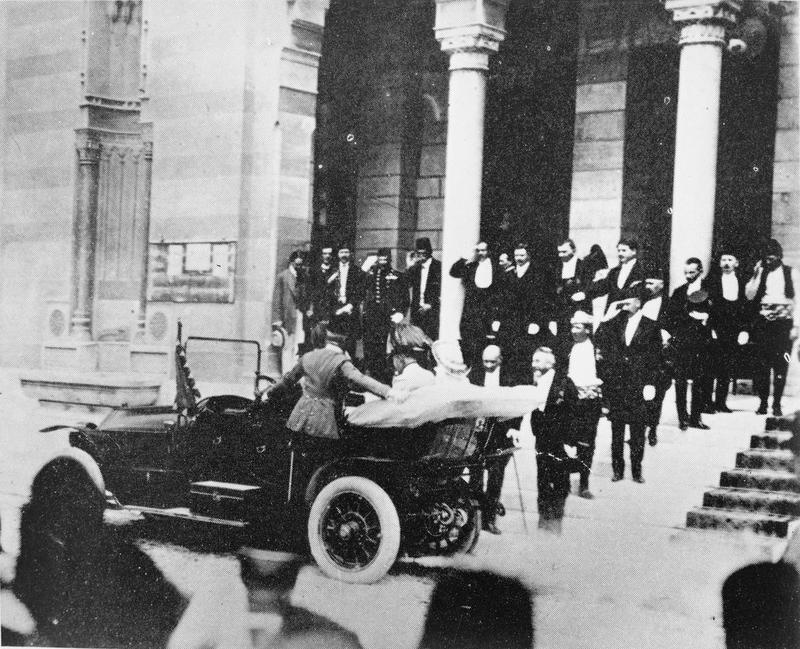
At the same time, nationalist movements were dismantling the Ottoman and Austro-Hungarian empires, both multiethnic structures with no obvious rationale for surviving in an age organized around the nation state. The Greek War of Independence and the Italian war of independence against Austria-Hungary are both examples of that unraveling. It's worth a passing note that Greek city-states like Athens and Sparta had historically seen themselves as rivals rather than as one people, which is part of why it was Alexander's Macedon, not Greece proper, that ended up conquering Persia. Inside Austria-Hungary, Slavic populations appealed to Russia for support. The assassination of the Austro-Hungarian heir by a nationalist in Sarajevo was the spark that, through this whole web of alliances, drew in Russia, Germany, and Britain and set off World War One, a war that, alongside World War Two, ranks among the deadliest in human history.
13The Beautiful Lie
World War One's aftermath produced an extreme form of nationalism: fascism. Benito Mussolini, its founder, described its foundational myth, the greatness of the nation, as something that need not be objectively real to function as a source of faith, hope, and courage. Fascism rests on the belief that a people exists in Darwinian struggle against other peoples, a struggle it must win to survive, and that unity and shared belief can make even an apparently weak nation invincible.
Filippo Marinetti glorified war as the only cure for the world, alongside militarism and patriotism, on the logic that war automatically unites a people and can be used to remake a population into more extreme nationalists. This current fed directly into the rise of both Hitler in Germany and Stalin in the Soviet Union.
14The Death of Judgment
Two thinkers tried to explain, after World War Two, how the catastrophe had been possible.
Hannah Arendt, in The Origins of Totalitarianism (one of the great works of twentieth-century political philosophy, and standard university reading ever since), argued that the ideal subject of totalitarian rule is not the committed Nazi or the dedicated communist, but a person for whom the distinction between fact and fiction, true and false, has simply ceased to exist. Totalitarian regimes systematically eroded people's capacity for independent judgment, effectively destroying the concept of the individual, and it was that erosion that let totalitarianism take hold in both Germany and the Soviet Union.
Karl Popper, a fellow European Jewish refugee from the same catastrophe, argued in The Open Society and Its Enemies that an open society is one in which people learn to be critical of taboos and to base decisions on their own intelligence rather than on inherited authority. For peace to prevail, societies must celebrate the individual rather than the nation, and must stay skeptical of grand theories of history that claim to know where history is headed, with Hegel, Marx, and Plato singled out as the three thinkers Popper regarded as most dangerous on this score, for being anti-democratic, anti-individual, and committed to a quasi-theological view of history moving toward a final endpoint. Popper's underlying project amounts to an argument for the superiority of Anglo-American civilization (more scientific, more incremental, more advanced) over both the Russian and German traditions, and that outlook is one of the intellectual foundations of what gets called the American Empire.
15Consumerism's Turn
A series of contrasts separates the World War Two era, organized around competing nation states, from the postwar American-led order: Pax Americana.
Where World War Two nationalism ran on mercantilism, separate trading blocs that gave powers like Britain, Germany, and France a reason to conquer colonies to sustain their own industrial production, the postwar American order promotes global free trade instead, on the theory that mutual trade among all parties tends toward peace. Where fascist nationalism organized around a unified will (the idea that a people acting as one becomes an unstoppable historical force), the contemporary era's organizing principle is, more cynically, consumerism.
Popper's open-society framework, as implemented inside the American-led order, generated newer social trends with no direct historical precedent: identity politics, built on the idea of individual vulnerability and a state whose core function is protecting the vulnerable (minorities, women, immigrants), and the celebration of mass immigration, a sharp break from earlier eras, when immigration was treated at best as an economic necessity and often met outright political resistance.
The combination of identity politics and celebrated mass immigration has produced a conservative political backlash, visible in the Trump administration and its deportation policies. The individual-rights-centered order built to solve the nation state's historical problems is, in turn, generating new problems of its own: problems that could plausibly bring nationalism back.
Which raises the question this whole first half of the map has been circling: what, if anything, separates nationalism from a cult? Not much, as it turns out: there is little fundamental difference between nationalism and religion more broadly. A cult tends to be smaller and more insular, and typically requires specific rituals. Nationalism, on the same terms, could reasonably be called a religion in its own right. Keep that in mind. Everything that follows is what happens when that religion runs low on believers, and its state turns to war to make more.
16The First War of This Century
This second half of the map opens against the backdrop of a ceasefire between Iran and the United States, one most analysts expect to collapse within weeks or a month, because no arrangement between the two sides can satisfy both of them at once. The claim at the center of it: this US-Iran conflict is the first true war of the twenty-first century, and what follows traces how warfare evolved to reach this point.
The simplest form of war, practiced for centuries, was to destroy a state's capacity to fight by killing as many soldiers as possible on a battlefield: whoever won the battle won the war. In the twentieth century, that changed. Nation states now had access to millions of people, which meant a state could always replenish its forces no matter how many soldiers died. So the goal shifted: instead of killing as many soldiers as possible, the point became destroying a state's capacity to produce and manufacture, which meant killing as many civilians as possible, and that is chiefly what happened in World War Two.
In the twenty-first century, the calculation shifts again, because of nuclear weapons and because there are simply too many people left to kill. An entire population cannot be killed, and using nuclear weapons invites nuclear retaliation. So the new goal is to turn a population against its own state: to sow enough discord and dissent inside a society that its own citizens do the work, achieved through economic sabotage and economic strangulation.
None of that makes sense without first asking why there are so many people left to turn into a weapon in the first place. The world's population has reached eight billion, a number most people treat as an unambiguous triumph, but the argument here cuts the other way: there aren't enough resources or space to comfortably support that many people. Strip away fertilizer and the planet supports one to two billion, not eight. The conventional explanation, that this growth comes from the scientific and technological revolution, doesn't actually hold up. The real reason is the nation state itself: a revolution in politics that emerged from the French Revolution.
17The Social Contract in Full
The chief architect here is Jean-Jacques Rousseau, who, despite being Swiss rather than French, built the social contract theory that underpinned the French Revolution. Before Rousseau, nobody really examined the individual's relationship to the state. People were born into a community and did whatever tradition, custom, and family required. Rousseau was the first to argue that people are born free, because God gave them freedom, and that the real question was why anyone would ever choose to surrender that freedom to join a community. His answer: people join society in order to become more free, not less.
Together, people create what Rousseau calls the common will, which works like basic democracy: a decision by majority vote, whichever option wins the most votes, the same way three friends might vote on McDonald's or Pizza Hut. But Rousseau considered this an inferior system, because people should strive to be higher than their current selves, to strive for total freedom, which is the general will. The common will is who people currently are. The general will is who people could become, if they came together properly as a people.
The general will runs through Kant's categorical imperative, the highest moral law, built on three principles. First, universality: imagine every action you take instantly reflected across the whole universe. Smile, and everyone smiles at once; get angry, and everyone gets angry at once. Then ask what kind of society you actually want to live in, and act accordingly. Second, free will: no one can be compelled to smile; a person must smile by their own free choice, because even if being made to smile produces happiness, forcing it violates the good of humanity. Third, humanity as an end in itself: no human being can ever be sacrificed to build a supposedly better society, because human beings are the ultimate end, never a means.
Together, these three principles produce the theory of the general will. Even if everyone votes to eat ice cream, that vote wouldn't represent genuine enlightenment or the ideal state, because a decision has to pass through Kant's categorical imperative to count as the general will, rather than merely the common will.
From the general will comes the sovereign: the highest law, functioning essentially as God. From the sovereign comes the state, the government. The state turns people into citizens, and from citizenship come laws, culture, and education. General will to sovereign to state to citizen to laws, culture, and education: that whole chain is Rousseau's social contract, and it was the ideal that French intellectuals and revolutionaries were reaching for when the French Revolution began.
Naturally, plenty of people disagreed, monarchs especially, since the theory holds that the people are sovereign, while in a monarchy the monarch is. It is fundamentally a dispute over who holds sovereignty. Since most European nations at the time were monarchies, they read the French Revolution as a direct threat and invaded France, repeatedly.
18Liberty or Death
Something strange happened next. Professional armies invading France kept losing to citizen armies made up of people with no military experience and no professional training at all. The explanation: Rousseau's theory was powerful enough to make people willing to fight and die for it.
Two passages from The Social Contract explain why. The first concerns slavery. Rousseau argues that to renounce one's liberty is to renounce one's status as a human being, one's rights as a human being, even one's duties as a human being: no compensation could ever be adequate for someone who gives up everything. Such renunciation is incompatible with human nature, since removing all freedom from a person's will removes all morality from their actions too. An agreement that grants one side absolute authority and the other unlimited obedience is empty and contradictory, since if one party can take everything from the other, there is no genuine obligation between them: nothing exchanged, nothing equivalent, sufficient to make the agreement valid. Rousseau's underlying point: freedom is given by God and is what connects a person to God, so it cannot be surrendered. Take someone's freedom away, and their humanity, their connection to God, is severed along with it. Therefore, better to die than to be a slave. This was, quite literally, the thinking of citizens during the French Revolution: ordinary people with no experience of firearms running straight into cannon fire against professional soldiers, because they held that liberty or death was the only real choice, since without liberty a person is nothing.
The second passage concerns population growth as the true measure of good government. Rousseau writes that he is continually astonished that such a simple sign of good government is not more widely recognized, or perhaps people do recognize it and are just not honest enough to say so. What is the purpose of any political association, he asks, if not the preservation and prosperity of its members, and what is the clearest sign of that preservation and prosperity, if not a growing population? The best government, all else equal, is the one under which population grows the most without outside help, without naturalizing foreigners or founding colonies; the worst is the one under which population shrinks. Count, measure, and compare for yourself, he tells his readers.
Two ideas fall out of this: liberty is the paramount value, and a good society has to prioritize population growth as the clearest sign it is thriving. On those two foundations, France became the greatest and most powerful empire in Europe, expanding to colonize and conquer vast stretches of the continent.
19Iron and Blood
As the French conquered new territory, the conquered peoples resented it and built their own theory of nationalism in response, one designed to explain how to defeat the French, but built on entirely different foundations than the social contract. This new theory rested on language, culture, and race, and it becomes Germany, summarized in the phrase iron and blood.
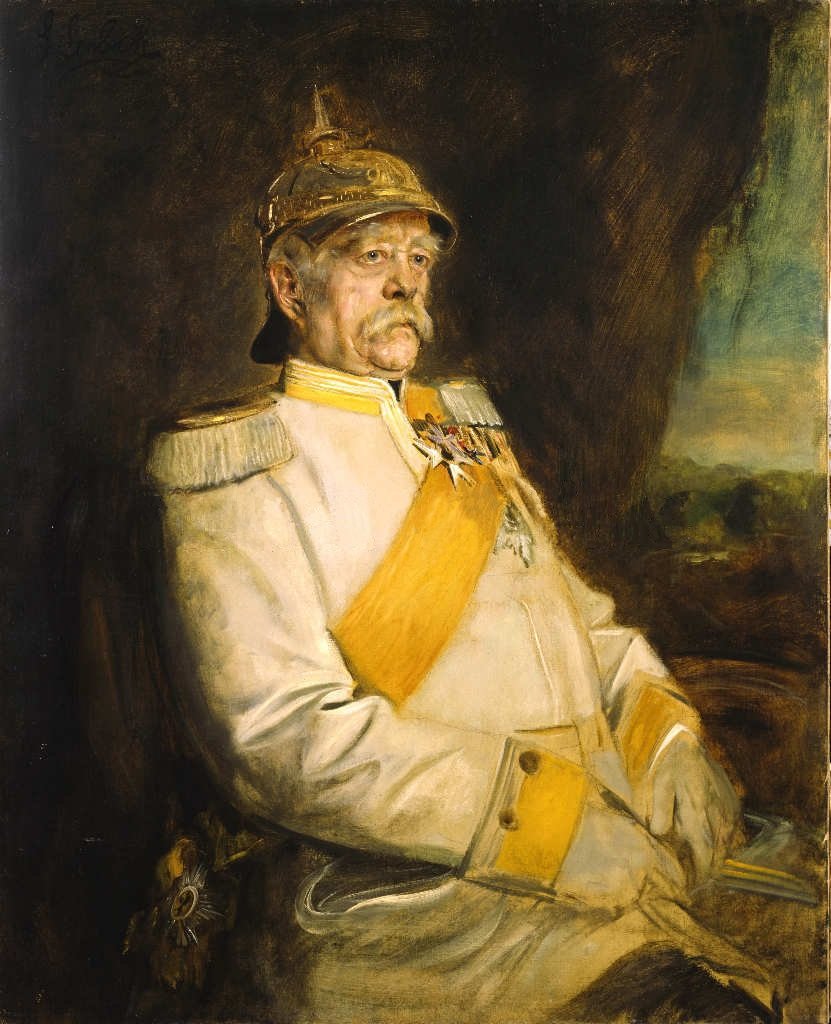
Johann Fichte, the father of German nationalism in this telling, argued that it is language, not liberty, that binds human beings: language connects people to their past, binds them together, and is worth fighting for, alongside race, nation, and blood. That becomes the operating philosophy of the German state. Germany at the time was still divided into hundreds of separate kingdoms; it is Otto von Bismarck of Prussia who unifies the German people into a single Germany, often called the Second Reich.
Bismarck's Iron and Blood speech makes the point without apology. The position of Prussia in Germany, he argues, will not be decided by its liberalism but by its power. Prussia must concentrate its strength and hold it for the favorable moment, a moment that has already come and gone more than once since the Treaties of Vienna, since the borders drawn there were poorly designed for a healthy body politic. The great questions of the age, he insists, will not be decided by speeches and majority votes (the great mistake of 1848 and 1849) but by iron and blood.
The message: as a German nation, as a people, freedom has to be protected through war, and it is only through war that the people can survive and thrive. But fighting wars effectively means taking care of the population that fights them. Bismarck himself wrote about the worker's real grievance: the insecurity of never being sure of steady work, of staying healthy, of foreseeing old age and eventual unfitness for labor, and the fact that falling into poverty, even through prolonged illness, left a worker completely helpless, since society at the time recognized no real obligation to such a person beyond ordinary poor relief, itself inadequate, especially in the cities. Bismarck's answer was to build Germany into the most powerful nation on earth by recognizing that soldiers alone don't win wars: the people who build the machine guns, the artillery, and the ammunition matter just as much, and keeping them healthy is a military necessity, not merely a moral one. That is why Bismarck passed a sweeping set of worker reforms (health insurance, accident insurance, old-age pensions, worker and child protections), all of it understood, at bottom, as instruments for producing warriors and sustaining a nation's capacity to fight.
Mussolini took the same logic further than anyone, grasping that the true purpose of a nation state is to fight wars, and that war itself gives people meaning. Build a nation state around war, construct a mythology around the beauty of war, and people will fight and die for it willingly. In his own words: we have created our myth, the myth is a faith, a passion, it is not necessary for it to be a reality, it is a reality in the sense that it is a stimulus, is hope, is faith, is courage; our myth is the nation, our myth is the greatness of the nation, and to this myth, this greatness which we want to translate into a total reality, we subordinate everything else.
20The Firebombing Peak
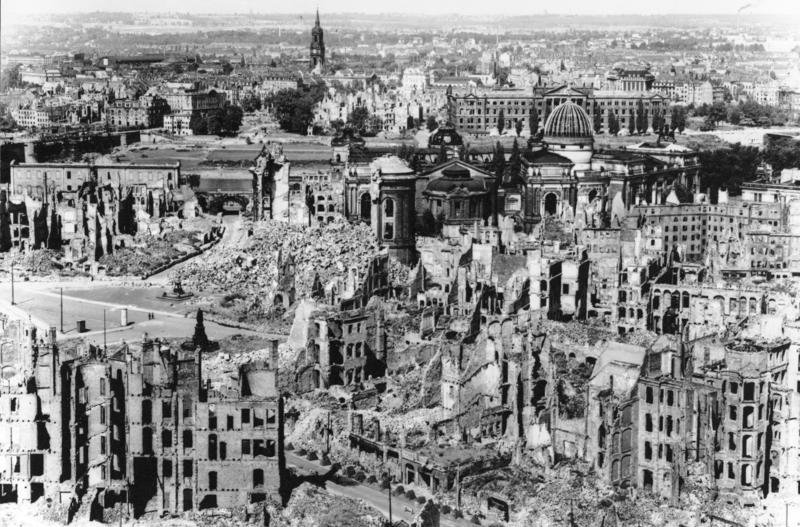
By World War Two, soldiers were no longer a mercenary class the way they had been in earlier centuries; they were drawn straight from the population itself, which meant killing soldiers on the battlefield no longer decided the outcome of the war. The Allies won not because they were more democratic, more moral, or better strategists, but because they could destroy the productive capacity of their enemies while their enemies couldn't destroy theirs. American factories sat untouched for the entire war. Soviet factories were relocated deep into Siberia, out of German reach. Germany and Japan, by contrast, could be firebombed directly. Between 1940 and 1945 the British and Americans firebombed German cities, Dresden among them, reduced almost entirely to rubble. Japan suffered even more: at least half the country overall was destroyed by American firebombing, with catastrophic damage in its major cities: Nagoya, comparable in size to Los Angeles, forty percent destroyed; Tokyo, comparable to New York, forty percent destroyed; Yokohama, sixty percent destroyed. The idea of the nation had become so powerful that winning a war required destroying the civilian population itself, and that is precisely how Germany and Japan were finally defeated.
And yet, despite tens of millions of deaths in World War Two, global population growth never actually stopped or reversed. For most of human history, population growth was slow and steady, but starting around 1600 it began to boom, a shift usually credited to the rise of science and technology. That explanation doesn't hold here either, since science and technology had always existed in some form. What actually changed was the rise of the nation state, and its recognition that winning wars required an ever-larger supply of people willing to die for the nation, which in turn required treating those people well enough that they wanted to reproduce and sustain the supply. The nation state, in other words, willed medicine and sanitation into being as tools for growing its own population.
21The Game America Built
Even before World War Two, a third theory of the nation state had emerged alongside the French and German models, distinct from both. America, built as a multicultural nation of immigrants colonizing the Western Hemisphere, had no single shared history or bloodline to draw on, so its founders built something else entirely: the nation state as a game. The Constitution and the federal government function as the rules and the referee, and the promise held out to anyone who comes to America is simple: work hard, get rich, and in doing so build the greatest nation in the world. Anyone can join the game, and the more players who join, the wealthier America itself becomes.
After World War Two, America spread that game as far as it could, first to Europe and Japan. Communist China and the Soviet Union held out, running their own separate game instead. It was only after the Soviet collapse that America's game finally conquered the world, in the form of globalization, sweeping up the last major holdouts.
That version of the postwar order, consumer capitalism, is unique in human history and, for most of its existence, extraordinarily successful: it grew the global population from about two billion to about eight billion and generated enormous wealth, China's own economic transformation over the past thirty or forty years being a direct product of playing the game.
But every game like this eventually runs into the same wall. As it continues, wealth concentrates among a shrinking number of winners while everyone else falls into debt, and inequality compounds. America built and grew this game deliberately, chasing as many players as it could get, which is part of why the population kept booming. But once a small number of people hold most of the wealth and everyone else is left in debt, those people become, in blunt terms, useless to the game itself, and the game needs to be reset. Historically, resetting a game like this has meant destroying it outright and starting over through large-scale war, which is a good part of why the world is once again approaching that point.
The system has reached a point of imbalance, unstable and unsustainable, which is a further sign the world is heading back toward war. Because there are now so many more people than there used to be, any return to large-scale war is expected to be enormously more costly in lives, potentially killing off a very large share of humanity. The war in Ukraine is, in this light, essentially a nineteenth-century-style war, closer in character to World War One than to anything more modern, still focused on killing as many soldiers as possible on a traditional battlefield.
Iran, by contrast, is the first genuine twenty-first-century war. America's initial approach followed a shock-and-awe strategy: decapitate the leadership, destroy the military, destroy production capacity, as fast as possible. It didn't work against Iran, because Iran had spent roughly twenty years preparing for exactly this scenario: decentralizing its command structure so that killing its leaders made little difference, since replacements were already in place, and hiding both its military assets and its production facilities inside mountains. Despite serious damage to Iran's war-fighting capacity, Iran remained functionally in the fight.
22Three Components
As a result, America is expected to shift toward a fuller twenty-first-century war strategy, built on three components.
The first is economic strangulation, aimed at destroying an entire economy rather than a military. The second is engineering ethnic tension, deliberately manufacturing as much internal conflict as possible between the different peoples living inside a targeted country. The third is the destruction of civilian infrastructure, specifically a population's access to water, electricity, and food, the basic necessities of life. The logic: when people can't access those things, they get angry, and that anger can be redirected toward their own government instead of the foreign power actually responsible for the destruction, since attacking your own government is far easier than attacking the military that is destroying your infrastructure in the first place.
This strategy has historically been avoided because deliberately targeting civilian infrastructure is a war crime under treaties like the Geneva Convention. But as a more direct war drags on without success, the expectation is that those restraints get abandoned in the interest of winning by any means necessary.
23Kharg Island
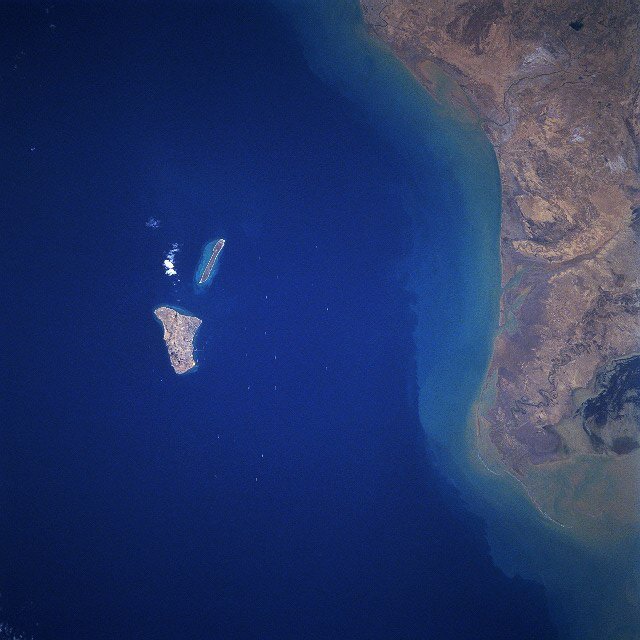
The current, more restrained targeting of weapons and military bases is ineffective and unsustainable, since no country has enough munitions to destroy an entire national military, which forces a more strategic approach, one that maximizes impact on the civilian population and the economy at the same time.
Water is the most basic target: dams and reservoirs across Iran, not all of them, but enough to create serious civilian pressure and public anger that could translate into protest against the government. Transportation networks, roads and railways, are next, and they matter because Tehran is a city of ten million people that does not grow its own food and depends on supply routes from the surrounding countryside; attacking key roads and transportation hubs makes it very hard to move food into the city without having to destroy the entire food supply outright. Power plants across Iran are comparatively easy to destroy and function as a third major target.
Strict adherence to attacking only soldiers and weapons would eventually exhaust available munitions without meaningfully reducing Iran's capacity or will to fight. Targeting key infrastructure instead (power plants, desalination plants, roads, railway networks) allows sustained damage over time without needing to destroy everything, with the explicit goal of making the civilian population angry enough to turn against its own government. The most effective weapon in this war, on this account, is no longer aircraft or aircraft carriers. It is the Iranian population itself, used indirectly against the Iranian state.
Economic strangulation specifically targets Iran's two primary sources of war financing. The first is oil exports, centered on Kharg Island, Iran's main oil depot, through which roughly ninety percent of Iranian oil exports pass, the overwhelming majority destined for China. American strategy calls for a blockade to stop those exports. The second is Iran's control over the Strait of Hormuz and the tolls it collects there, which America aims to disrupt using ground forces: seizing Kharg Island, seizing the coastline, forcing Iran to respond militarily to the incursions. Additional forces are positioned in Iran's northwest and southeast specifically because those regions are home to ethnic minorities, with the explicit intent of encouraging local uprisings against the Iranian state, forcing Iran to divert resources from controlling the strait toward suppressing several simultaneous ethnic insurgencies, expanding the battlefield and stretching Iran's capacity to respond on multiple fronts at once rather than delivering one decisive knockout blow.
24Weather Warfare
This overall approach is one America has reportedly used for a long time, in subtler forms. In 2012, Iranian president Mahmoud Ahmadinejad accused the United States of conducting weather warfare against Iran by artificially inducing drought: cloud seeding, in which a chemical called silver iodide is released into clouds to force rain to fall elsewhere before it can reach its intended destination, in this case diverting rain away from Iran. By 2019 there was genuine concern that Iran might face sustained long-term drought, while regions like Dubai (which some Iranians claimed to be the source or beneficiary of this manipulation) saw flooding instead. This particular claim is unproven and largely rumor, though plausible enough to be worth mentioning.
A related and more overtly conspiratorial claim involves a program called HAARP, originally built to study the atmosphere but which some believe has been repurposed to generate extreme weather events: hurricanes, cyclones, floods, drought. This, too, is a conspiracy theory, though one worth noting for how often it circulates.
More solidly established is a 1962 quote from Lyndon Johnson, later president of the United States, stating that whoever controls the weather will control the world, a line that frames the future of warfare as being less about weapons and more about weather control, since the capacity to induce drought in a targeted country could be enough to destroy it outright. Between 1967 and 1972, during the Vietnam War, the United States ran an operation called Operation Popeye, seeding clouds specifically to extend the monsoon season over Vietnam, making it harder for Vietnamese forces, who relied on tunnel networks, to resupply themselves, while American forces attacked primarily from the air. That program is well documented and genuinely happened; what remains debated is how effective, powerful, and scalable this kind of weather manipulation technology actually is, or has become since.
25Cuba and the Color Revolution Playbook
Elements of twenty-first-century warfare are already visible around the world. Cuba is a live example: under an oil embargo that produces regular blackouts, with the explicit intention not to kill civilians directly or fight a conventional war, but to strangle a nation until its own population rises up to overthrow its government.
A recent wave of accidents has also hit the world's oil supply, alongside the observation that North America is comparatively insulated from any resulting energy or refinery losses, given its own wealth and resources, meaning that if the rest of the world faces energy and food scarcity, it may increasingly have to lean on North America, the United States, Canada, and Mexico, for those resources, further consolidating American leverage over the wider world.
A further tool is what gets called the color revolution playbook: inviting young people from various countries to the United States to learn about democracy and how to organize protest movements framed as promoting democratic change, financing NGOs abroad to build youth movements, and using control over social media platforms to galvanize populations and stoke unrest. The Arab Spring protests of 2010 to 2012 across the Middle East are one example, where Twitter and Facebook played an instrumental organizing role.
The 2025 protests in Nepal, in which young people succeeded in overthrowing the government, are a recent example of the same playbook, with a specific piece of evidence offered: protest signs written in English, phrases like "okay boomer," "times up," and "we pay you flex enough," despite the fact that most of the local population involved neither speaks nor reads English. The argument: since these slogans would have no organic local audience or impact inside Nepal itself, their presence suggests the protests, or at least this messaging, were funded and organized for the benefit of an external audience, specifically Washington, rather than genuinely reflecting a domestic movement. This specific claim, like the weather-warfare material above it, is asserted without independently cited evidence and should be treated as a contested interpretation, not an established fact.
This overall capability, the ability to strangle a nation's economy and orchestrate internal uprisings using the local population itself, is something America can potentially deploy against any country that opposes it, underpinned by American control of the world's major maritime choke points: the Strait of Malacca, the Panama Canal, Gibraltar. Even where a rival power, like Iran with the Strait of Hormuz, controls a regional chokepoint, the United States retains the ability to project naval power elsewhere, stationing aircraft carriers in the Indian Ocean to blockade Iran regardless. This overall framework connects to a broader belief that America's underlying long-term goal is to economically damage China specifically, given how heavily the Chinese economy depends on exports and international trade: disrupted trade could mean falling GDP, rising unemployment, and potentially significant internal unrest inside China as a result.
26Population Management
Twenty-first-century warfare, in sum, is fundamentally about population management. Since an enemy is actively trying to provoke unrest inside a population in order to destroy the state from within, the logical response is to manage one's own population more effectively, a phrase that explicitly can include lethal measures: denying people food to create deliberate famine, spreading disease, direct violence against one's own citizens. This is part of why an AI-powered surveillance state becomes a practical necessity, since the most effective way to control a large population is through comprehensive AI surveillance. This outcome is simply an unavoidable feature of history at this stage: there are too many people now, states still want to fight wars, and large numbers of people are going to die in the process regardless of the specific methods used.
27How a Targeted Country Can Respond
Which raises the obvious question: how does a country under this kind of attack actually respond? Take Iran as the specific example. When a stronger power destroys an economy, destroys infrastructure, and pursues a divide-and-conquer strategy against internal minorities, game theory allows for only one genuinely effective countermeasure: call it eschatology, the deliberate cultivation of religious or nationalist fanaticism among a suffering population. The logic: when people are suffering, lack sufficient food, and see no hope for the future, the way to sustain resistance is to frame that suffering as part of a divine plan, one in which the suffering itself produces the invincibility and courage needed for martyrdom, with martyrdom understood as a path directly to heaven.
The acknowledged problem with this approach is that most people do not actually want to die for a cause like this; they would rather live an ordinary life. But history shows that only a relatively small fraction of a population (ten to twenty percent, by one estimate) needs to genuinely commit to this kind of eschatological fervor for a country to survive an otherwise overwhelming attack.
The Iran-Iraq War of the 1980s, an eight-year conflict, is the concrete historical example. Iraq, backed militarily by both the Americans and the Soviets, had tanks, helicopters, a full professional army. Iran, by contrast, had essentially no standing army, no tanks, no helicopters at the outset. In response, Iran's leadership told its population that the greatest possible glory was to become a martyr, to die for the nation and for God, and large numbers of young people, some as young as sixteen, went directly into battle armed with nothing more than a rifle, charging tanks and helicopters while screaming defiance at the enemy. Many were killed instantly. Some got close enough to throw grenades directly into enemy tanks.
Two effects followed. First, it galvanized the broader Iranian population into sustained resistance, eventually turning the tide of the war to the point where Iran was, for a period, actually winning, a trend only reversed once the Americans began supplying and encouraging the use of chemical weapons against Iranian forces, without which Iran might well have gone on to defeat Iraq outright. Second, this kind of fearless, suicidal resistance had a powerful psychological effect on the other side, since facing an enemy soldier armed only with a rifle and a grenade, showing no fear of death at all, is itself deeply intimidating to a soldier operating from inside a tank.
Twenty-first-century warfare, as mapped across this whole essay, can look effectively invincible. Eschatological fanaticism is the one demonstrated historical counter to it. The expectation, on this account, is that the coming years will see a significant global surge in exactly this kind of religious fervor and extremism, precisely because it remains the only real countermeasure available against this form of warfare.