1Two Men Named Jesus
Jesus is the most famous person who has ever lived. Around two billion people, roughly a quarter of the human race, worship him, and his name has shaped civilizations, empires, laws, moral codes, art, politics, war and peace, and the inner lives of countless human beings across two thousand years. Yet the most basic questions about him remain surprisingly hard to answer. Who was he? What did he actually believe? And why did one man, living and dying in an obscure corner of the Roman Empire, become the center of the largest religion on earth? The lecture's first move is to separate two figures who are usually treated as one: the historical Jesus and the biblical Jesus. They are not necessarily the same person, and much of the confusion in arguments about Christianity comes from sliding between them without noticing.
The historical Jesus was a real man of the first century. He was born around 4 BCE and was associated with Galilee, a region in the north of the land of Israel, connected to Judea and governed within the Roman imperial system. Galilee sat at a meeting point of cultures, languages, religions, and ideas, open to many of the great intellectual currents of the ancient world, and Jesus emerged from that unusually mixed environment. He became a follower of John the Baptist, a major Jewish religious figure who preached baptism as a way of cleansing sin before the coming kingdom of heaven. The idea was simple and urgent: God is coming, and before He arrives, human beings must wash away their sins, begin again, and make themselves ready. Jesus spent time inside this movement, then developed a following of his own and began preaching his own message. He became known as a healer; the sick came to him, and healing became bound up with faith, belief, and spiritual transformation. Then, sometime around the years 30 to 33 CE, when he was in his mid thirties, he was crucified by the Romans.
The precise charge against him is not fully known, but the method of execution is revealing in itself. The Romans did not crucify respected members of the elite. Crucifixion was among the most humiliating and brutal deaths the ancient world devised, reserved for bandits, pirates, slaves, rebels, and others who defied Roman authority, and especially for people of low status. The victim was fixed to a cross and left to die slowly. Death did not usually come from loss of blood; the body weakened over hours or days until the muscles could no longer hold it upright, breathing became harder and harder, and the victim finally suffocated. This is what happened to Jesus. From a strictly historical perspective, a basic outline can be established with more confidence than any of the details: Jesus lived; he was born around 4 BCE; he was associated with Galilee; he had a connection to John the Baptist; he built a following; he was known as a healer; and he was crucified by Rome. Beyond that, certainty dissolves. Jesus is one of the most studied individuals in human history, and remarkably little about him can be established beyond dispute.
2The Gospel Story
The biblical Jesus is a different kind of figure. He is the Son of God, existing in heaven, looking down on a suffering humanity, and moved by compassion for it. He wants to redeem human beings from pain, sin, corruption, and separation from God, and so he enters the world. He is born to a virgin named Mary, shows extraordinary spiritual intelligence from an early age, gathers twelve apostles, and preaches the coming kingdom of heaven: God is coming, and human beings must prepare. His religion emphasizes forgiveness, redemption, compassion, generosity, and mercy. He tells people not to judge one another, since only those without fault may cast the first stone, and since everyone carries mistakes, weakness, guilt, and sin, no one is in a position to condemn. He is also a social and religious revolutionary. The religious order of his day is bound up with priesthood, temple ritual, and animal sacrifice; faith is demonstrated through offerings, religion becomes a kind of tribute, and sacrifice is how a relationship with God is maintained. Jesus challenges this. Faith, he teaches, is shown not by killing an animal and paying the temple but through goodness, generosity, compassion, and mercy, and through the rejection of greed, corruption, and attachment to material things. That puts him in direct conflict with the religious authorities, above all those connected to the Temple in Jerusalem.
The story moves on to betrayal. Judas Iscariot, one of the twelve, betrays Jesus; religious authorities accuse him and hand him over to the Roman governor, Pontius Pilate. In the gospel account Pilate appears reluctant. He cannot see what crime Jesus has committed and seems unwilling to execute him, but the priests insist and the crowd insists, and finally he agrees to the crucifixion. Jesus dies, and then he is resurrected. He appears again to his followers and explains that he came to redeem humanity and atone for its sin; his sacrifice has accomplished its purpose. God will come, the earth will be cleansed, and the apostles must go out and spread the gospel, a word that means good news. He promises, too, that he will return. There will be a second coming, in glory, when the forces of evil are defeated, God's enemies are destroyed, and a new paradise emerges. That is the biblical story, and it raises a question that has troubled Christianity for almost two thousand years without a simple answer.
3Why the Son of God Must Die
If Jesus is the Son of God, why must he die at all? How can the Son of God die, and why would God require a crucifixion? Why should salvation depend on a sacrifice? The standard Christian explanation begins in the Garden of Eden. God creates humanity and places Adam and Eve in paradise, where they can live freely under a single command: do not eat from the tree of the knowledge of good and evil. They disobey and eat the fruit, and this becomes original sin. God is angered, Adam and Eve are expelled from paradise, and humanity is separated from God. The human race goes on making mistakes; sin accumulates, corruption increases, and the world grows more violent, selfish, and broken.
In this account God waits for humanity to admit its fault, but human beings refuse. They are stubborn and ignorant, and they do not know how to ask for forgiveness, and God, however merciful, must somehow be asked. Jesus, the Son of God, sees the impasse: humanity cannot save itself. So he enters the world and sacrifices himself, and his death atones for the sins of the human race. Through it the separation between God and humanity can be overcome; God can forgive, and human beings can be released from their guilt. The lecture suggests, however, that the story can also be read in another register, psychologically, and that read this way it reveals something the theology alone does not. God is not only forgiving humanity. Humanity is being given a way to forgive itself.
4Achilles and Priam
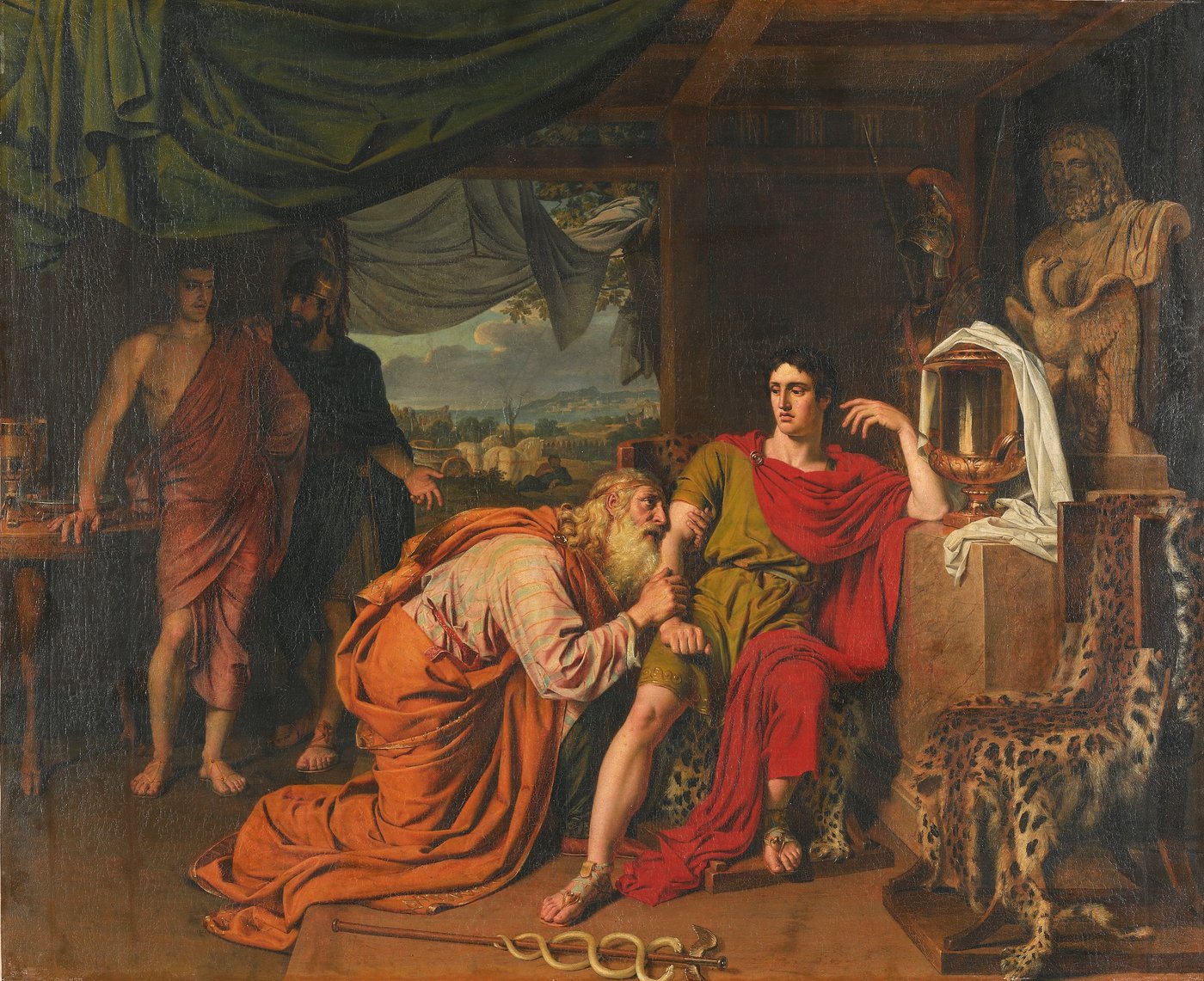
To show what that means, the lecture turns to Homer. The Iliad centers on Achilles, the greatest warrior among the Greeks at Troy, who withdraws from the fighting because Agamemnon has insulted him. His pride is wounded, yet he still longs to fight, and his anger and arrogance help bring on disaster. His closest friend, Patroclus, goes into battle in his place and is killed. Achilles becomes even more furious, but beneath the fury lies guilt. He is angry at himself, and he cannot admit his own failure or forgive himself for it. So he turns the anger outward. He kills Hector, the Trojan prince who killed Patroclus, and then drags and defiles Hector's body day after day, trapped inside a grief he cannot escape.
Then Priam arrives. The old king of Troy, Hector's father, comes alone at night into the enemy camp, kneels before the man who killed his son, and kisses the hands that did it, asking only for his son's body. That act of mercy releases Achilles. The two men weep together, each for his own dead, and Achilles finally lets go of his rage. He could not free himself from his guilt, but another person's mercy opened the door. This, on the lecture's reading, is the deeper problem Christianity answers: what happens when human beings cannot forgive themselves? The answer is Jesus. Jesus forgives you. Do not remain trapped in guilt, do not hate yourself forever, do not believe your mistakes define you permanently; you can become new, and you can begin again, because Jesus has atoned for the guilt, and if you believe, you can be reborn. That, the lecture argues, is one of the deepest emotional powers of the Christian story: it makes it possible for a human being to imagine a new self.
5The Torn Curtain
The sacrifice also changes who can reach God. Before it, God is understood within Judaism, where the relationship with the divine is bound to a particular covenant, a particular people, a particular sacred history, and a particular religious institution. Within the Temple system, access is narrower still: only the high priest may enter the holiest space. Then Jesus dies, and the Gospel of Mark records a crucial image. Jesus gives a loud cry and breathes his last, and the curtain of the Temple is torn in two, from top to bottom. That curtain guarded the inner sanctuary, the Holy of Holies, the place associated with the presence of God, which only the high priest could enter, and only on one day a year. When it tears, the barrier disappears. God is released. The divine is no longer confined behind priesthood, Temple, and sacred architecture, and humanity as a whole now has access.
Then something else happens in Mark's account. A Roman centurion is standing by. He is not Jewish, and he watches Jesus die and declares that this man was truly the Son of God. On this reading, the first person in the gospel to recognize Jesus fully is not one of the apostles at all. It is a Roman: a foreigner, an outsider to the Jewish religious world, and indeed an officer of the empire that has just executed him. The meaning is universal. God is no longer restricted to one people but available to all of humanity, and the sacrifice of Jesus opens the relationship with the divine to everyone. That idea becomes one of the foundations of Christianity, and one of the reasons it could spread so far beyond the land where it began.
6Three Problems With the Story
Serious problems remain, and the lecture names three. The first concerns original sin. The story of Adam and Eve is not as simple as later theology suggests. Adam and Eve do disobey God and eat from the tree, but the story also presents God as complicated. He tells them they will die on the day they eat, yet the consequences unfold differently. And God punishes humanity directly and at once: Adam is condemned to labor, to struggle for his food against the ground, and Eve to pain in childbirth. Humanity has already been punished. God then expels them from paradise, the text says, so that they do not also eat from the tree of life and live forever. All of this complicates the idea that a later sacrifice was needed to pay off an unresolved debt. The second problem is the anger of God. If God is perfect, eternal, and all-knowing, why is He angry at His children? Why must human beings ask before the Father forgives? Would a loving father stay furious forever with children who are ignorant and weak? Is forgiveness the responsibility of the child, or of the parent? The story is emotionally powerful, but examined closely it becomes difficult.
The third problem is historical, and it has had terrible consequences. The gospels repeatedly create the impression that the Jewish authorities were responsible for the death of Jesus, and across the centuries that impression has been used to justify antisemitism, persecution, and massacre. Yet first-century Jewish society was not a single religious bloc. It contained competing schools, and the historian Josephus names three major ones. The Sadducees were closely tied to the aristocracy, the priesthood, and the Temple, and represented its central religious authority. The Pharisees emphasized obedience to the law of God, challenged the idea that Temple sacrifice alone defined religious life, and gave rise, after the Temple's destruction, to the rabbis who shaped later Judaism. The Essenes expected an approaching divine intervention and stressed disciplined, simple, communal lives of peace and separation from corruption. These groups disagreed deeply; they competed, argued, and often disliked one another. But theological disagreement did not ordinarily mean handing a religious opponent over to Rome to be executed, because all of them still understood themselves as belonging to God's people. That makes the idea that the Jewish religious authorities simply decided to kill Jesus historically questionable.
7Pilate as History Remembers Him
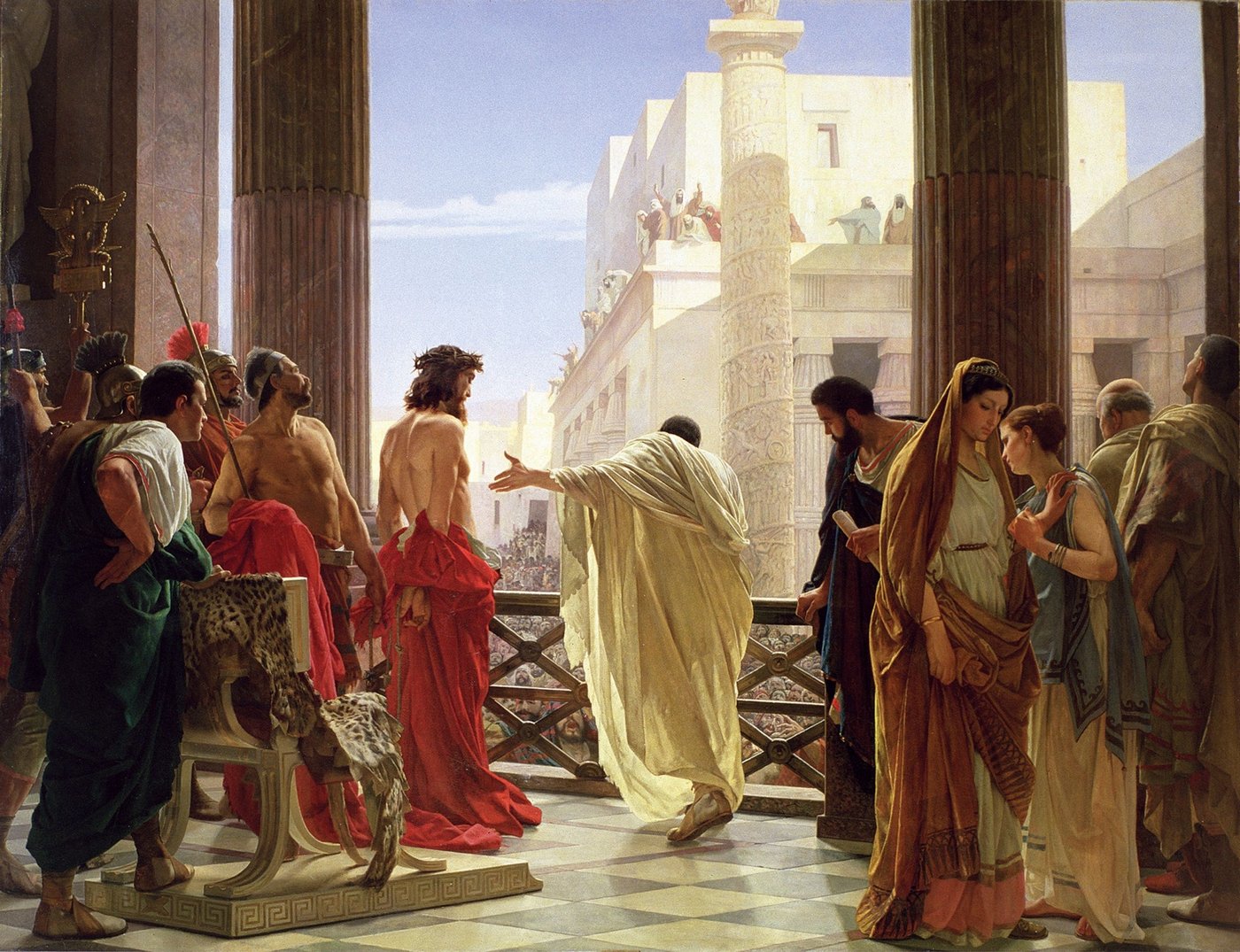
Then there is Pontius Pilate. The Pilate of the gospels is reluctant, almost sympathetic, visibly uncomfortable with the execution of Jesus. The Pilate of the historical record looks very different. Rome was direct and brutal, and its governors did not hesitate to kill, and Pilate in particular had serious conflicts with the Jewish population he governed. The first commandment prohibited idols, and Rome represented its emperor everywhere through coins, military standards, images, and the symbolism of the imperial cult; the cult of Caesar could directly offend Jewish law. According to Josephus, Pilate had standards bearing the emperor's image carried into Jerusalem by night. Crowds of protesters went to him at Caesarea and refused to leave, and when he had soldiers surround them with drawn swords, they threw themselves to the ground, bared their necks, and declared that they would rather die than see their law violated. Pilate had to back down. Other confrontations ended in bloodshed.
This was not a gentle or politically delicate ruler, and the picture of a Pilate who deeply sympathized with Jesus while Jewish authorities forced his hand becomes hard to sustain against it. From here the lecture builds an alternative reconstruction of who Jesus was and what he taught, and it attaches an important caveat that deserves to be repeated: this reconstruction is not the conclusion of a specialist biblical scholar. It comes out of independent reading and historical interpretation. It can be challenged and questioned, and it should be. It is an argument. And to follow it, you first have to reconstruct the long history of Judea and Jerusalem that came before Jesus was born.
8Six Conquerors
King David stands near the beginning of the story. Around 1000 BCE, David becomes one of the great founders of Israelite political and religious identity, and his reign is remembered as a high point of confidence: a kingdom powerful, open, and generous. His son Solomon inherits it, but the political structure cannot hold together, and after Solomon's death the kingdom splits into a northern kingdom, Israel, and a southern one, Judah. Because the Levant sits at the crossing of the major trade routes and in the path of every imperial ambition, both kingdoms are vulnerable. The northern kingdom falls to the Assyrians in 722 BCE. Judah falls to the Babylonians, who destroy Jerusalem and its Temple in 587 BCE and carry the elite into exile in Babylon. During that exile Judaism takes on a more structured form: exile becomes central to identity, and scripture, law, memory, and covenant become ever more important. Then the Persian Empire rises, and Cyrus the Great allows the exiles to return. A second Temple is built, and the biblical tradition is organized and written down in a more developed form, with an important stage placed around the fifth century BCE.
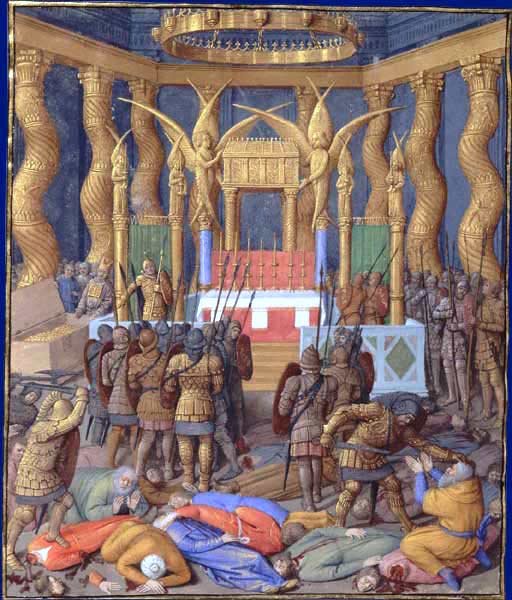
Then the Greeks arrive. Alexander the Great transforms the region, and Greek culture spreads across it. After Alexander, the Ptolemaic kingdom of Egypt becomes especially important: Egypt is wealthy, and Alexandria becomes the great center of learning of the ancient world. There the Hebrew scriptures are translated into Greek, in the version known as the Septuagint, and this matters enormously, because Christianity would later develop largely in a Greek-speaking world among people who did not read Hebrew, and the Greek Bible would become its foundation. Then comes the rule of the Seleucid kings. Around 167 BCE, Antiochus IV desecrates the Temple; a pig is sacrificed on an altar to Zeus, an act experienced as an almost unbearable religious insult. Jewish resistance follows in the form of the Maccabean revolt, a long guerrilla war that eventually wins independence under the Hasmonean kings, who rule until Rome arrives. Then Rome arrives. In 63 BCE the Roman general Pompey besieges and takes Jerusalem; the siege is violent, thousands are killed, and many others are enslaved and scattered across the empire. Jesus is born only a few decades later, into a society that has been conquered again and again: by Assyria, by Babylon, by Persia, by Alexander's Greeks, by the Seleucids, and by Rome.
9Punishment or Apocalypse
That history produced a theological crisis. If the Jewish people are chosen by God, why does this keep happening? Why are foreign empires victorious? Why is the Temple violated? Why do outsiders kill God's people, and why does God permit their humiliation? Two great explanations emerged. The first was punishment. The people have not been faithful enough; God has allowed foreign conquest because they disobeyed, worshipped foreign idols, broke the commandments, and failed to stay loyal. The empires are instruments of discipline in God's hand, and God is chastening His people so that they will return to Him.
The second explanation was apocalyptic eschatology. Eschatology is the study of the end: the end of history, the end of the world, the final transformation of all things. Apocalypse means revelation, or unveiling. Apocalyptic eschatology is therefore the unveiling of how history will end. On this view, the suffering of the present is temporary. God is preparing to return; the empires will be destroyed, the enemies of God will be punished, and a new divine order will emerge. This was an immensely powerful idea in the world of Jesus. Many Jews expected the end times, many prophets announced an imminent divine intervention, and Jesus was not the only person preaching the coming kingdom. The claim that God was about to return was everywhere, and Jesus emerged inside that broader apocalyptic environment.
10The Crossroads of the Ancient World
But Judea and Galilee were also connected to a far larger world, and the Levant was its meeting place. Greek philosophy was present there, and Persian religion, and Egyptian ideas, and Roman philosophy, and the mystery cults; and Hindu and Buddhist traditions belonged to wider networks of exchange that reached into the region along the trade routes. In the lecture's interpretation, Jesus absorbed ideas from this whole religious environment and synthesized them into a new spiritual system, one that was not yet Christianity, since Christianity came later, and which the lecture identifies with Gnosticism. Greek philosophy offered Plato and the Form of the Good. For Plato, the Good is the highest reality, the source from which truth, beauty, justice, and reason flow. The visible world is not ultimate reality but an imperfect reflection of it, a shadow, behind which stand the deeper Forms, and the task of philosophy is to rise from appearance toward truth. The realm of Forms becomes a kind of higher reality, almost a heaven, and mathematics becomes especially important because mathematical order seems closer to eternal truth than unstable physical things. The lecture connects this to Egyptian sacred geometry, in which geometry could be understood as the language and thought of the gods: reality contains a hidden structure, and the physical world is not the final truth.
Persian religion contributed another pattern through Zoroastrianism. There, the creator is the perfect God of light, who makes a good world that an evil force then corrupts. Human beings become participants in a cosmic struggle, free to choose good or evil, and history moves toward a final confrontation. A savior will arise, a messianic figure; the forces of light will meet the forces of darkness, and good will triumph. Then come resurrection and judgment: the dead will rise, human beings will pass through a final test, the good will be purified and the evil will suffer, and paradise will follow. The structure strongly resembles later Christian eschatology. Hindu and Buddhist thought offered yet another pattern: a deeper reality behind the visible world, and human suffering rooted in ignorance, attachment, false perception, and repeated cycles of rebirth. In Hindu thought, Brahman is the ultimate reality, and the individual can move toward moksha, which means release, escaping through right action, discipline, knowledge, and transformation from a false or limited world back toward the true one. That, too, resembles Plato: the physical world is not our final home, and the human task is awakening.
The ancient world also had its great philosophical schools, Stoicism, Cynicism, and Epicureanism, and Cynicism matters especially to this reconstruction. The Cynic rejected attachment to material reality. Fine clothes did not matter, nor status, nor wealth, nor social respectability; the individual should live simply, beg if necessary, reject false values, and refuse the illusion that material success equals truth. Parts of the teaching attributed to Jesus sound very like this. There were also pagan rituals and mystery traditions, some associated with Dionysus, in which people gathered to produce altered states, sometimes with intoxicants, cultivating a religious ecstasy that could dissolve ordinary identity into a feeling of unity and interconnection. Many of these rites also challenged hierarchy: a slave and a rich man could share the same sacred experience, and the usual divisions of society could temporarily disappear. The whole region was charged with religious intensity, full of people searching for truth, liberation, and connection, for a more peaceful reality, and for a way beyond empire, hierarchy, suffering, and material corruption. Jesus emerged inside this climate, and in the lecture's account he was a religious genius who drew its many ideas together into a new spiritual system.
11Three Layers of One Teaching
To understand that system, the lecture suggests imagining a religion as having several layers. There is a public layer, given to everyone; an inner layer, given to disciples; and a secret layer, held only by the founder and the closest followers. These layers can speak differently and still belong to one system, as different levels of the same truth. In this reconstruction, the public Jesus teaches compassion, mercy, forgiveness, and equality, and the Sermon on the Mount stands at the center of it: blessed are the poor in spirit, for theirs is the kingdom of heaven. At the public level the message is simple. The poor have value; God does not measure worth by wealth; the suffering are not abandoned; a poor person may lack food, status, and power and still be loved by God. The public message offers hope.
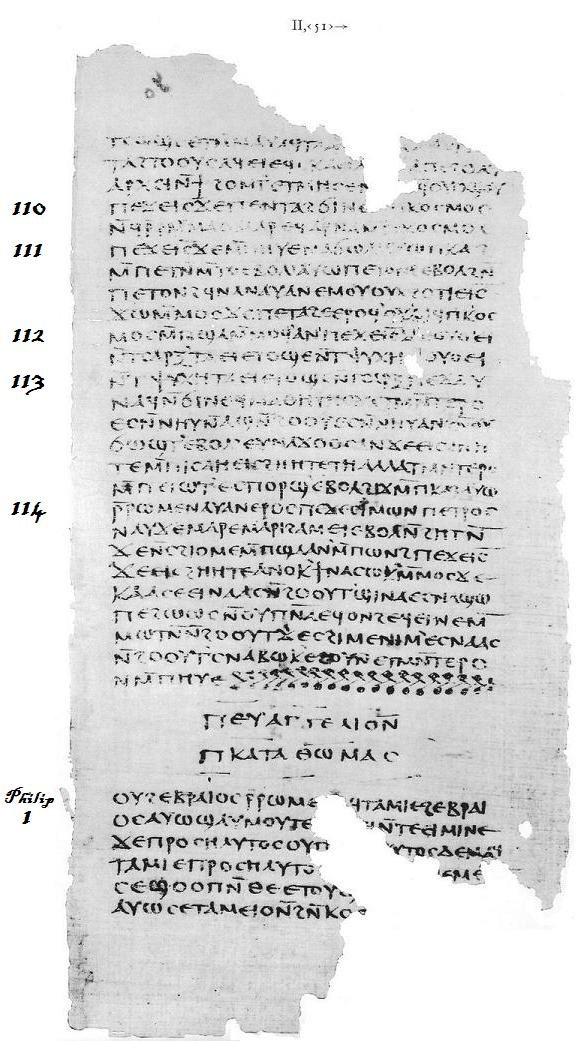
The inner teaching is more demanding. If you truly want to follow the path, attachment must be surrendered. If you are wealthy, give up your wealth; if family and property stand in the way of spiritual transformation, leave them behind. The disciple must become an example and live the teaching, because it is not enough to praise compassion; one must embody it. Then comes the secret level, and the lecture finds it in a text that is not part of the Christian Bible at all. The Gospel of Thomas, a collection of sayings attributed to Jesus, was rediscovered in 1945 among the codices buried near Nag Hammadi in Egypt. One of its sayings declares that there is light within a person of light, and that it lights up the whole world; if it does not shine, there is darkness. The saying can be read at every level. At the public level it means: be good, show compassion, act generously, and bring light into the world through moral behavior. At the inner level it means the disciple must sacrifice attachment and become an example to others. At the secret level, it points toward a divine spark within the human being, and that leads directly into Gnostic cosmology.
12The Monad and the Monster
At the beginning, in Gnostic thought, is the Monad: the One, the perfect God, eternal, unchanging, and complete. From that perfection emerge other divine realities, described as pairs or emanations, and among them is Sophia, whose name means wisdom. The divine world remains ordered, and perfection produces perfection. Then something goes wrong. In texts like the Apocryphon of John, also found at Nag Hammadi, Sophia tries to create on her own, outside the proper relationship, imitating the creative power of the Monad without its order. The result is a malformed being, a monster, sometimes named Yaldabaoth. Ashamed, Sophia hides the creature away in another realm, where it knows nothing of the true divine world. It is ignorant of the Monad and believes itself to be God. It is lonely, and so it creates: it makes the material world, and it makes human beings. In this Gnostic interpretation, the creator identified with the God of the Hebrew scriptures is not the highest God at all but a lower, ignorant creator, a distorted being, and the world is broken because its maker is broken.
This becomes an explanation for suffering. Why do bodies feel pain? Why do children suffer? Why do people fall sick, grow old, and die? Why would a perfect God create a world like this? The answer, in this reconstruction, is that the perfect God did not create this material prison directly; a lower creator did. But the lower creator does not completely control humanity, because inside human beings something from the true divine reality remains: a spark, a light, a fragment of the Monad. The body belongs to the broken world, while the divine spark belongs to the true one. Salvation therefore does not come through blind obedience to the material creator. It comes through awakening, through knowledge, through what the Greek word gnosis names: you must remember who you are, discover the light within you, and understand that the visible world is not ultimate reality. This, the lecture argues, is the secret teaching of Jesus.
13When the Two Become One
From this vantage point, even the blessing of the poor takes on a new meaning. To succeed completely inside a corrupt material system, a person may have to become more like the system. The wealthy and powerful can become deeply invested in domination, mastering the game the lower world has set up, while the poor may remain less attached to it; they hold less material power, but they are also less invested in corruption. Therefore, blessed are the poor. The saying is not simply about economic suffering. It is about distance from a false reality. The person who dominates a monstrous world may become monstrous, while the person who stays outside the system may remain closer to the divine spark.
Another saying in the Gospel of Thomas becomes central here. When you make the two into one, it says, and make the inside like the outside and the outside like the inside, and the above like the below, and make male and female into a single one, and when you make an eye in place of an eye, then you will enter the kingdom. The false world creates categories: rich and poor, male and female, ruler and subject, priest and layman, Jew and Gentile, master and slave. The material system divides, and the deeper truth is unity. Human beings are interconnected, and the same divine spark exists in all of them. Compassion therefore becomes something more than moral kindness. It becomes recognition: you show mercy because the person in front of you is not ultimately separate from you, you reject hatred because the divisions of the world are not the final truth, and you seek unity because unity reflects the deeper reality. The saying also speaks of replacing the eye. Human beings have eyes, but what they see may be false; the physical eye sees appearances, and the spiritual eye sees truth. You must learn to see with the soul, with the divine spark, and then the false world becomes visible as false.
14The Execution That Spread the Message
In this reconstruction, Jesus does not die because God demands a blood payment for original sin. Death is not the ultimate disaster, because the material world is already a prison, and death may even be a return to the deeper reality. But his death serves another purpose: it awakens attention. The crucifixion was so violent, so public, and so tragic that people could not ignore it. The Romans meant to destroy Jesus, and instead the execution made him unforgettable. People began to ask questions. Who was he? Why was he killed? What did he teach? Why did Rome fear him? The death captured human attention, and by focusing on Jesus, people focused on his teachings; by focusing on the teachings, they could begin a process of self-discovery through which the deeper message might emerge: compassion, mercy, generosity, the rejection of false material values, the recognition of the divine spark, awakening, and escape from a false reality. Jesus became more powerful in memory than he had ever been in life.
The lecture sketches how this might have happened. At some point Jesus came to believe his message strongly enough to carry it to the center, and for a religious teacher who wants influence, Jerusalem is the center. But Jerusalem was dangerous. The Romans were there, and the religious authorities, and competing prophetic movements, and Jesus had no powerful faction to protect him. The Romans were suspicious of prophets for good reason, because apocalyptic preaching could become rebellion: if a man announces that God is returning, the political implication may be that Rome is doomed, and a coming kingdom of heaven can sound like a challenge to the kingdom of Caesar. Jesus became visible, and the Romans arrested and crucified him. The execution was meant as a warning, and it produced the opposite effect.
The lecture offers a parable to show why. Imagine a king whom everyone hates, and three prophets who appear to denounce him. The first says the king is illegitimate, the second that he is a murderer, the third that he steals from his own army. The people do not know which prophet is telling the truth. Then the king executes one of them, and immediately the dead prophet gains credibility. Why did the king kill him? What did he know? Why was he dangerous? The execution itself becomes evidence in the public imagination, and the martyr grows larger than the teacher ever was. The same mechanism transformed Jesus, and it was especially powerful in a society already expecting the end of days, already wondering whether the Messiah might be near, when Rome crucified a prophet and charged his death with meaning. Gnosticism, in turn, became attractive because it explained the world people actually lived in. Why does the world hurt? Because it is broken. Why are the powerful so often corrupt? Because material power belongs to a false order. Why do human beings still feel beauty, love, truth, and transcendence? Because a divine spark remains inside them. Why be compassionate? Because beneath every social division, humanity is one. Why reject attachment to wealth? Because attachment binds consciousness to the material prison. And why does knowledge matter? Because awakening is liberation.
15From Jesus to Paul
This reconstructed Jesus is radically different from the Jesus of later Christianity. The Gnostic Jesus teaches that the light is within you; later Christianity teaches that salvation comes through belief in Jesus. The Gnostic Jesus directs attention toward awakening; later Christianity directs it toward Christ as redeemer. The Gnostic Jesus teaches discovery, and later Christianity teaches faith in his person. The Gnostic Jesus teaches that the divine spark can free the individual from a false world, while later Christianity teaches that Jesus died to atone for human sin and will return to save the world. These are not minor differences of emphasis. They are different religious systems, and the gap between them creates the central question of the whole lecture.
How did the religion of Jesus become the religion about Jesus? How did a teaching centered on the divine spark become a religion centered on redemption through Christ, inner awakening become institutional belief, a teacher become an object of worship, and a movement become a church? The answer, the lecture argues, leads to Paul, and with it comes a sharp distinction: Jesus is not presented here as the true founder of Christianity. Paul is. Christianity is the religion about Jesus, but it is not necessarily the religion Jesus himself taught. In the hands of those who came after him, the teacher became the redeemer, the prophet became the Son of God, the execution became atonement, the memory became doctrine, and the movement became Christianity, while the inner divine spark slowly disappeared behind the institution built in his name. That is the transition this volume has been tracing: from Jesus to Paul, from teaching to doctrine, from awakening to belief, from the religion of Jesus to the religion about Jesus.